Tel : 86-0755-89999957 /
  Email : colin@aohuadz.com






Introduction
If you’re sourcing waterproof connectors for outdoor lighting, EV charging stations, solar farms, or industrial equipment, you’ve probably seen ratings like IP67, IP68, and IP69K.But what do these numbers actually mean? More importantly, which one is right for your application?
Choosing the wrong IP rating can lead to premature failure, costly downtime, and safety risks. Choosing the right one ensures long-term reliability – and saves you money.
In this guide, we’ll break down:
-
What IP67, IP68, and IP69K mean in plain language
-
A side-by-side comparison table
-
Real-world applications for each rating
-
How to avoid common mistakes
-
Where AOHUA fits in
Let’s dive in.
What Do IP Ratings Mean?
IP stands for Ingress Protection. The first digit (6) means dust-tight – no ingress of dust. The second digit (7, 8, or 9K) means water protection level.
All three ratings are dust-tight (IP6X). The difference is entirely in how they handle water.
-
IP67 – Protected against temporary immersion (up to 1 meter for 30 minutes)
-
IP68 – Protected against continuous immersion (beyond 1 meter, manufacturer-specified)
-
IP69K – Protected against high-pressure, high-temperature water jets (steam cleaning)
| Feature | IP67 | IP68 | IP69K |
|---|---|---|---|
| Dust protection | Dust-tight (6) | Dust-tight (6) | Dust-tight (6) |
| Water protection | Temporary immersion | Continuous immersion | High-pressure / high-temp jets |
| Immersion depth | Up to 1 meter | >1 meter (manufacturer specified, e.g., 2m, 5m, 10m) | Not for immersion – for washdown |
| Immersion duration | 30 minutes | Continuous (manufacturer specified, e.g., 24h, 48h, or permanent) | N/A |
| Pressure resistance | No | No | Up to 100 bar / 1450 psi |
| Water temperature | Ambient | Ambient | Up to 80°C (176°F) |
| Typical test condition | 1m for 30 min | 2m+ for 24h+ | 14-16 L/min at 100 bar, 80°C |
| Best for | Outdoor rain, splashes, puddles | Submersible applications, marine, ponds |
Food processing, heavy washdown, off-road vehicles |
Detailed Breakdown: IP67
What it means:
The connector can be submerged in water up to 1 meter deep for 30 minutes without damage.
Where it’s used:
-
Outdoor LED lighting (street lights, garden lights)
-
Junction boxes in rainy environments
-
Agricultural sensors (brief wet conditions)
-
General outdoor industrial equipment
Limitations:
Not suitable for continuous underwater use. If your application is in a manhole that occasionally floods, IP67 is fine. If it stays underwater for hours or days, you need IP68.
Our products:
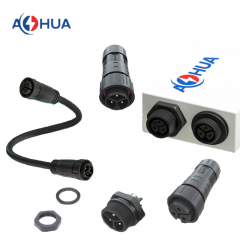
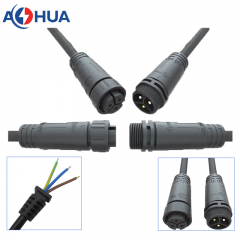
M12/M15/M16/M20/M25/M29
Detailed Breakdown: IP68
What it means:
The connector can withstand continuous immersion under conditions more severe than IP67. The exact depth and duration must be specified by the manufacturer (e.g., 2 meters for 72 hours, or 10 meters permanently).
Where it’s used:
-
Marine electronics (boat lighting, sonar)
-
Underwater pumps and sensors
-
Swimming pool equipment
-
Fountain lighting
-
Submersible cables in solar farms
Why depth matters:
A connector rated IP68 at 2 meters may fail at 5 meters. Always check the manufacturer’s spec sheet. At AOHUA , we clearly state our IP68 ratings (e.g., IP68 – 5m for 48h).
Our products:
M12/M15/M16/M20/M25/M29
Detailed Breakdown: IP69K
What it means:
This is NOT for submersion. IP69K is for environments where connectors are blasted with high-pressure, high-temperature water – often during steam cleaning or washdown processes.
Where it’s used:
-
Food and beverage processing lines (frequent washdown)
-
Pharmaceutical manufacturing
-
Commercial car washes
-
Heavy-duty off-road vehicles (tractors, construction equipment)
-
Industrial automation where chemical/steam cleaning is required
Important note:
IP69K does not mean the connector is suitable for prolonged submersion. Some connectors carry both IP68 and IP69K ratings – those can handle both immersion and washdown. Always verify.
Common Mistakes Engineers Make
Mistake 1: Choosing IP68 “just to be safe” when IP67 is enough
IP68 connectors are more expensive. If your application never sees submersion beyond a puddle, IP67 will save you money.
Mistake 2: Assuming all IP68 is the same
Always check the depth and duration spec. One manufacturer’s IP68 (1.5m for 24h) is very different from another’s IP68 (10m permanent).
Mistake 3: Using IP69K for underwater applications
IP69K is not immersion-rated. It will leak if submerged for long periods. Look for IP68 + IP69K dual-rated if you need both.
Mistake 4: Ignoring the sealing material
Even with the right IP rating, poor sealing material (e.g., low-grade rubber) will degrade over time. At AOHUA , we use high-performance fluororubber or silicone gaskets for long-term reliability.
Which One Should You Choose? (Quick Decision Guide)
| Your application | Recommended rating |
|---|---|
| Outdoor light, occasional rain | IP67 |
| Junction box in a pit that floods sometimes | IP67 |
| Pond fountain, always submerged | IP68 (check depth) |
| Marine deck light, splashed but not always submerged | IP67 or IP68 (IP68 for safety) |
| Submersible pump at 5m depth | IP68 (specified for 5m+) |
| Food factory washdown with steam cleaner | IP69K (or IP68+IP69K) |
| Car wash high-pressure spray | IP69K |
Why AOHUA Connectors Are Different
We don’t just stamp IP ratings on a datasheet. Every connector batch is tested in-house using:
-
Water immersion chambers (IP67/IP68)
-
High-pressure jet testers (IP69K)
-
Salt spray corrosion tests
-
Thermal shock cycling
We also provide full traceability and test reports upon request.
Explore our product lineup:
-
M12/M15/M16/M20/M25/M29
Need Help Choosing?
Still not sure which rating is right for your project?
Contact our engineering team – we’ll review your application and recommend the best solution. No obligation, just honest advice.
Share This Guide
If you found this useful, bookmark it or share it with your team. We regularly update our guides to help engineers make better decisions.

 86-0755-89999957
 colin@aohuadz.com